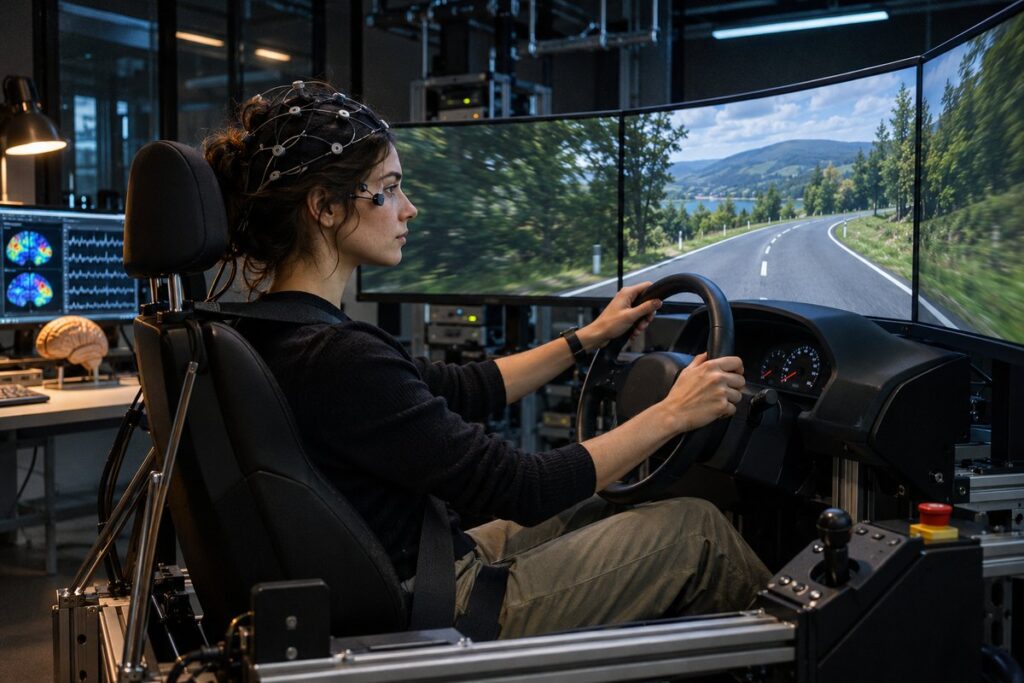
Ninety minutes into a California driving study, 81 people who had smoked cannabis were prepared to drive. Earlier in the session, considerably fewer had been willing to do so. It would be reasonable to expect the simulator to show a similar recovery. Instead, the driving scores of the THC group had barely budged from their first post-smoking test. The volunteers were answering a question about an intended decision. The steering wheel was registering something else.
Before anyone touched the wheel
The randomized trial led by Thomas Marcotte enrolled 191 regular cannabis users. On the study day, participants smoked a placebo cigarette or a cigarette containing one of two concentrations of THC. They controlled how much they smoked, a deliberate choice that made the session resemble an ordinary decision about when to stop. It also meant that the percentage printed in the research protocol was a poor guide to how much THC any one participant actually took in.
Participants had completed a baseline drive, giving the team a record of their performance before smoking. They returned to the simulator several times. Before each drive they were asked whether they would drive in their current condition. Asking before the test preserved an important detail: people had to make a judgment without first seeing whether they could manage that particular stretch of simulated road.
The hour when the two records diverged
Half an hour after smoking, 57 of 120 respondents in the THC group said they would drive. The simulator recorded poorer performance in that group than in the placebo group. At 90 minutes, willingness had risen from roughly 48 percent to nearly 69 percent. The group’s performance was still impaired relative to placebo and showed no corresponding improvement from the earlier test.
That is a group comparison. It would be a mistake to single out all 81 willing drivers as people who had personally failed a driving test. The researchers combined several performance measures into a score and compared distributions. There was no licensing examiner in the passenger seat delivering 81 individual verdicts. The striking result was the pace at which willingness returned while the measured deficit persisted across the group.
By four and a half hours, the average driving score was statistically indistinguishable from placebo. The two groups resembling one another at a scheduled observation cannot establish a universal time of recovery. Nor does a simulator contain the full set of demands that a person might encounter on a real road. A separate on-road study measured how much a car moved from side to side within its lane after vaporized cannabis. The advantage of the simulator is repeatability: drivers can face closely comparable demands at different points in the same afternoon.
Does the same mismatch appear after an edible?
A later randomized crossover trial of cannabis edibles gives the question a different answer under different conditions. Investigators used measured oral doses, tested participants at prespecified intervals and observed dose-related changes in driving performance. Participants were generally less willing to drive at higher doses. Here the subjective and objective findings pointed more often in the same direction. Recognizing an effect, however, still did not supply an individual test of fitness to drive.
The contrast helps explain why researchers specify route, dose and timing so carefully. In a review of acute THC effects on driving and cognition, those features helped account for variation across experiments. A smoked cigarette taken at the participant’s own pace and an edible containing a measured amount set different problems for the observer.
The California experiment captured something that disappears in a single question asked at the end of a study. Willingness was already changing between the first two drives. An observer with only the questionnaire would have seen an encouraging upward trend. An observer with only the simulator would have missed the moment many participants were ready to take the keys.